Sales & Marketing Technology
Digital Bevy Product
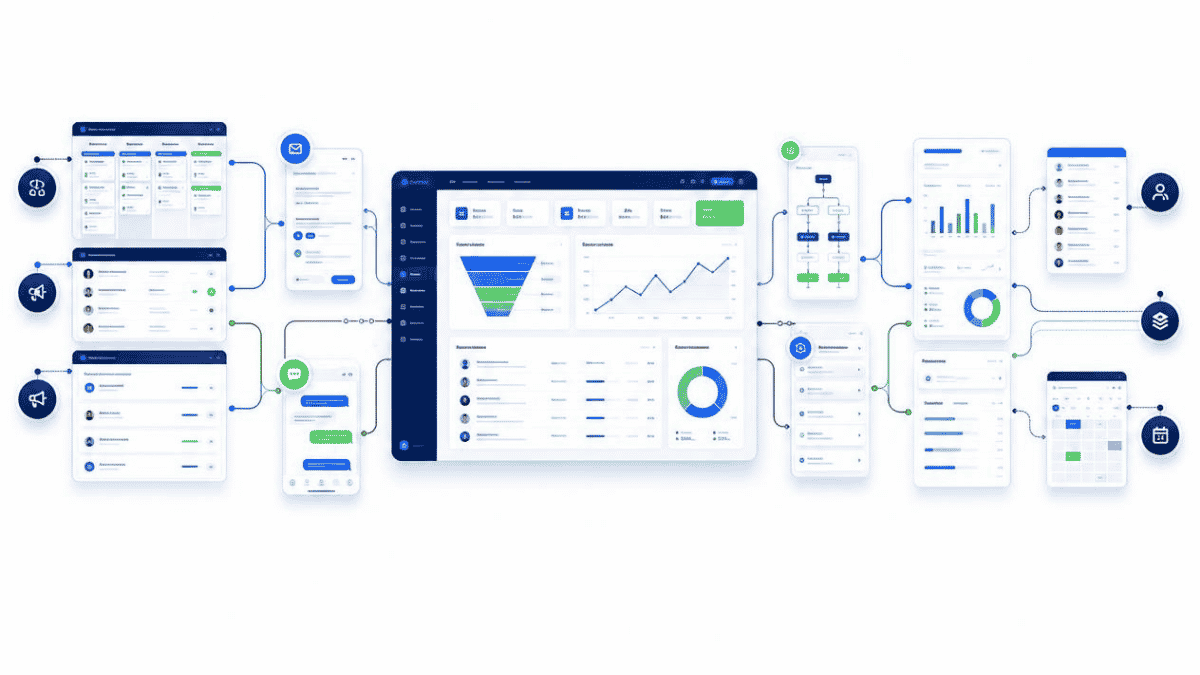
Revenue teams often operate across a fragmented technology stack. CRM may exist in one system, email campaigns in another, telephony elsewhere, social publishing in another tool, while analytics, AI workflows, data enrichment and internal project management introduce additional platforms.
Each system may solve an individual problem, but the overall customer and revenue workflow becomes increasingly disconnected. Customer information is distributed across systems, teams repeatedly switch applications, integrations become harder to maintain and organizational context is difficult to preserve.
ActoryX began with a broader product question:
What would a revenue operations platform look like if CRM, marketing automation, communications, AI, analytics and customer engagement were designed as connected components of the same system?
The challenge therefore extended beyond building another CRM. It required a scalable SaaS architecture capable of supporting multiple organizations while bringing traditionally separate revenue-operations functions into one extensible platform.
Digital Bevy designed ActoryX as a unified sales, marketing and customer-engagement platform built around a shared organizational data model.
CRM forms the operational core, while marketing automation, communications, analytics, social publishing, enrichment, AI agents and customer-engagement capabilities connect to the same underlying customer and organizational context.
The architecture was designed around modular capabilities rather than independent applications. This allows individual functions to evolve while continuing to participate in shared workflows, permissions and data relationships.
As the product expanded, the engineering focus also moved beyond visible features into multi-tenancy, organization-scoped authorization, authentication, auditability, encrypted integration credentials, API protection and configurable white-label environments.
ActoryX remains under active development, with production capabilities and integrations introduced progressively rather than presenting planned functionality as already available.